
You load the bar. You set your stance. You pull hard and then your hands give out before your legs or back do. Sound familiar? Grip failure is one of the most frustrating limiters in deadlifting. You know your posterior chain has more in the tank, but your fingers simply won’t cooperate.
The good news: this is fixable. In this guide, we’ll walk you through exactly why grip fails on deadlifts, how to train it directly, and when using a quality lifting strap like the DMoose Lifting Straps makes sense to keep your progress moving forward.
Why Does Your Grip Fail on Deadlifts?
Your grip is made up of several muscle groups, the forearm flexors, extensors, and the small intrinsic muscles of the hand. These muscles fatigue faster than your glutes, hamstrings, and lower back, which are far larger and stronger. When you’re pulling heavy weight off the floor for multiple sets, your grip is simply the weakest link in the chain.
Several factors make this worse:
- Sweaty hands reduce friction between your palms and the bar
- Smooth barbells offer less texture to grip
- Fatigue accumulates across sets, especially during high-volume training
- Neglecting direct grip training leaves a real strength gap
Choose the Right Grip Style First
Before reaching for a strap or chalk, make sure you’re using the right grip type for your training stage.
Double Overhand
Both palms face you. This is the weakest grip for heavy singles, but it’s the best grip for building raw grip strength. Use it for warm-ups and lighter working sets.
Mixed Grip (Over-Under)
One hand pronated, one supinated. This prevents bar roll and significantly increases how much you can hold. Most powerlifters use this for near-max and max effort pulls. The downside: asymmetrical loading on the shoulders over time if you always use the same hand orientation. Alternate which arm supinates each set.
Hook Grip
You wrap your thumb under your fingers. Used extensively in Olympic weightlifting. It’s extremely secure but takes weeks of adaptation due to thumb discomfort. Worth learning if you compete in powerlifting or Olympic lifting.
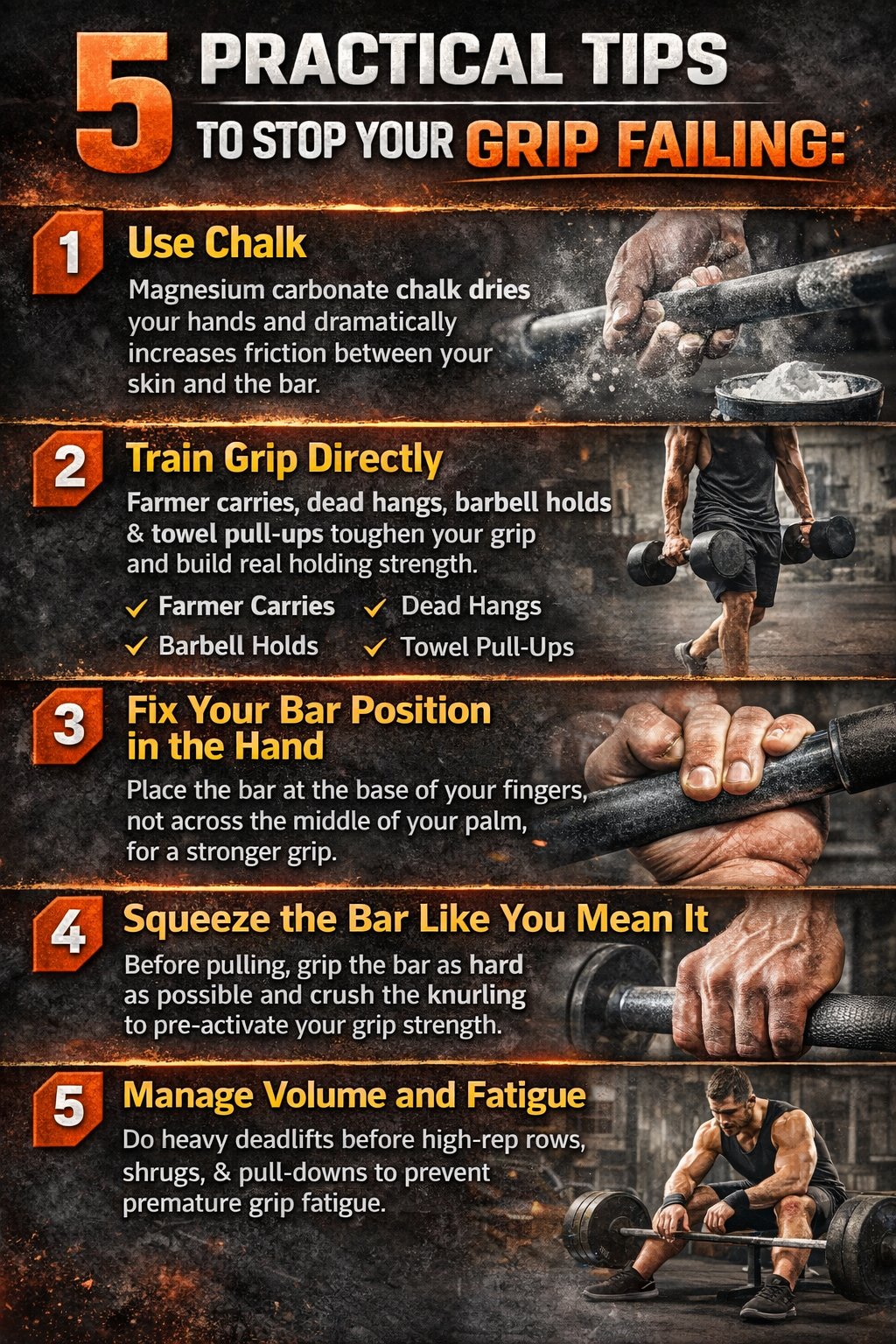
5 Practical Tips to Stop Your Grip Failing
1. Use Chalk
Magnesium carbonate chalk dries your hands and dramatically increases friction between your skin and the bar. Most serious lifters consider chalk the first intervention before any other tool. If your gym allows it, use it on every heavy set.
2. Train Grip Directly
Most lifters never train grip as its own thing. Add these into your routine 2–3 times per week:
- Farmer carries: Walk with heavy dumbbells or kettlebells for 30–60 seconds
- Dead hangs: Hang from a pull-up bar for time, progressing to one hand
- Barbell holds: Load a bar heavy, deadlift it, and hold at the top for 10–20 seconds
- Towel pull-ups: Loop a towel over the bar and do pull-ups gripping the towel
Consistent grip training will add significant holding strength within 4–6 weeks.
3. Fix Your Bar Position in the Hand
Many lifters grab the bar across the middle of the palm. This is wrong. The bar should sit at the base of your fingers, the meat just above where the fingers meet the hand. This reduces the moment arm on your wrist and massively improves mechanical grip efficiency. Small adjustment, big difference.
4. Squeeze the Bar Like You Mean It
Many lifters approach the bar passively. Before initiating the pull, actively crush the bar as hard as possible. This pre-activates your forearm flexors and sets a strong neural signal through the chain. Think: try to leave fingerprints in the steel. Your whole body braces better when your grip is engaged first.
5. Manage Volume and Fatigue
Grip fails faster when it’s already accumulated fatigue from earlier exercises. If you’re doing high-rep rows, shrugs, and pull-downs before deadlifts, your grip arrives at the deadlift pre-exhausted. Consider ordering your session so that heavy deadlift work comes before high-rep pulling movements.
When Should You Use Lifting Straps?
There’s a common debate about straps: do they make you weak by “cheating” the grip? The answer is more nuanced than that. Straps are a tool, and like any tool, timing matters.
Use straps when:
- Your working weight has surpassed what your grip can hold for the required reps
- You’re doing high-rep accessory work (e.g., Romanian deadlifts, rack pulls, shrugs) where grip is not the training objective
- You want to accumulate volume on the big lift without grip being the bottleneck
- You’re coming back from a wrist or hand injury and need to keep training the posterior chain
The key is to keep building raw grip strength separately while using straps strategically. You’re not replacing grip training you’re making sure grip doesn’t constantly interrupt your pulling development.
Best Lifting Straps for Deadlifts: DMoose Lifting Straps
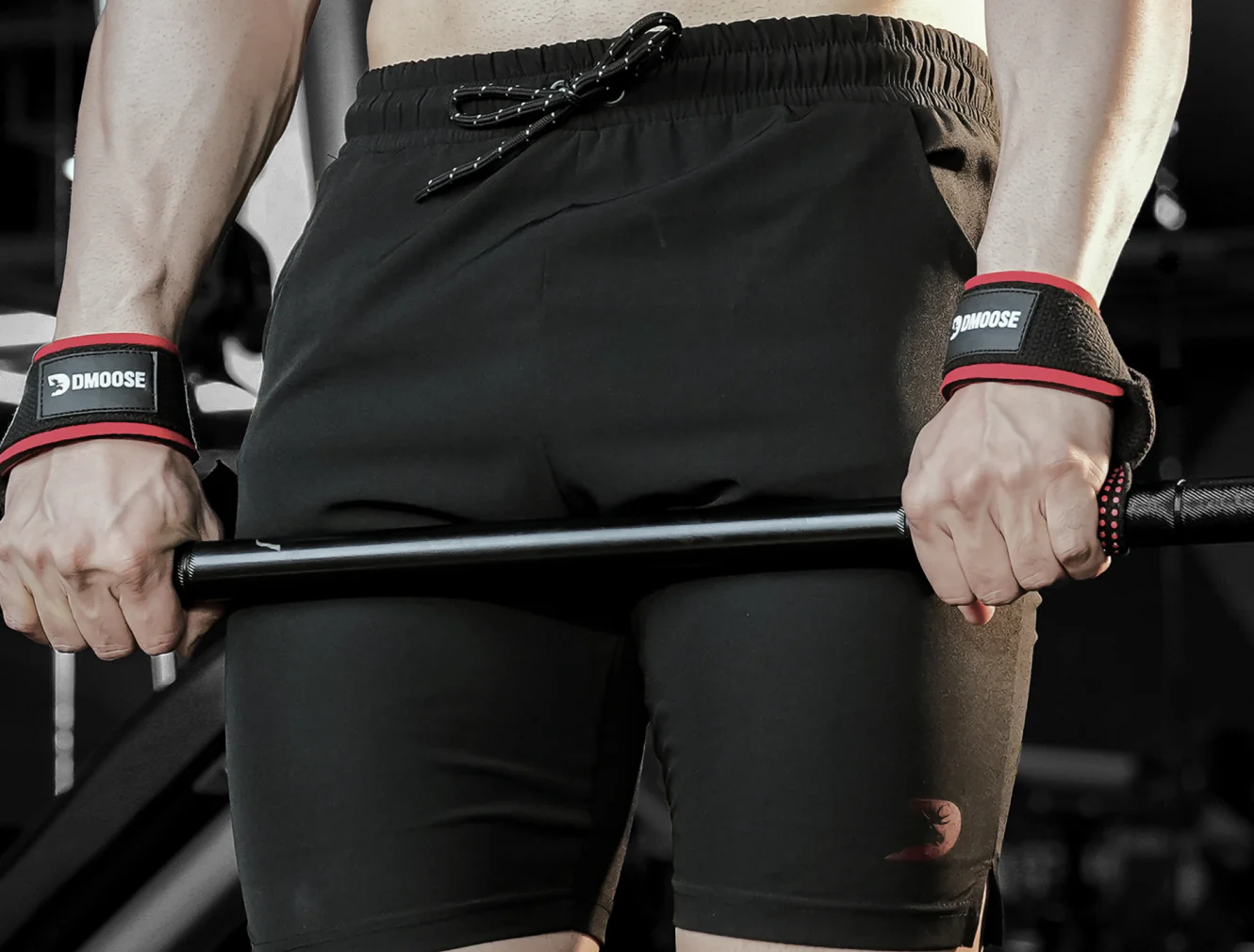
If you’re going to use straps, use ones that actually hold up under heavy load. The DMoose Lifting Straps are a well-regarded option built specifically for this purpose
Here’s what makes them effective for deadlift training:
- 24-inch length: Long enough to wrap multiple times around both the bar and your wrist, creating a rock-solid connection that won’t slip under heavy loads
- Non-slip silicone threading: Integrated grip pattern locks onto the bar even when your hands are sweaty mid-set
- 5mm neoprene wrist padding: Protects your wrists from the pressure and friction of heavy pulls without sacrificing feel
- Durable cotton with reinforced stitching: Holds up to daily training without fraying or losing structural integrity
These work equally well for rack pulls, barbell rows, shrugs, and any other heavy pulling movement where grip is the limiting factor rather than the target muscle.
How to Use Lifting Straps Correctly
A lot of lifters use straps incorrectly and wonder why they slip. Here’s the right method:
- Thread the strap through the loop to create a lasso around your wrist
- Position the tail of the strap so it hangs toward your thumb side
- Set up at the bar and loop the strap under and around the bar toward you
- Roll the bar slightly into the strap to cinch it tight
- Grip the bar normally over the wrapped strap and pull
Once the weight loads the strap, it self-tightens. You shouldn’t need to re-adjust mid-set. If the strap is sliding, recheck that you’ve wrapped it toward yourself rather than away.
Putting It All Together: A Practical Approach
Here’s how to combine everything into a real training approach:
- Warm-up sets: Double overhand, no straps build raw grip strength with every session
- Working sets up to ~80%: Mixed grip or double overhand with chalk
- Heavy sets and high-rep accessory work: Straps as needed to keep quality high
- 2–3x per week: Direct grip work, farmer carries, dead hangs, bar holds
Follow this consistently for 8 to 12 weeks and your grip will no longer be the thing that stops your deadlift from progressing. The straps keep your sessions productive in the meantime.
Final Thoughts
Grip failure on deadlifts isn’t something you just accept. It’s a fixable problem with a clear solution: train your grip consistently, use chalk, dial in your bar position, and use a quality lifting strap when the load outpaces your current grip capacity.
The DMoose Lifting Straps are a solid, no-fuss option that handles the grip side so your back, hips, and legs can do the work they’re supposed to do.
Stop letting your hands limit your pulls. Train smart, strap up when it counts, and keep adding weight to the bar.