

I sit for a living, eight or nine hours parked at a desk, and by mid-afternoon my lower back has usually tightened into a knot that someone seems to have pulled taut and forgotten about. My first attempt at a remedy was a little handheld face panel, which was undeniably cute but lit up roughly the area of a paperback. So I spent every session sliding it up and down my spine like I was ironing a wrinkled shirt. Relaxing, it was not.
So I decided to go considerably bigger. The Helio Glow is the panel I eventually landed on, and I have a love affair with it, so a fair amount of bias is baked into everything below. Even so, I want to walk you through why this device suits this problem, where the underlying science lands, and where you ought to pause before spending the money.
Who This Is For
Helio Glow is a floor-standing panel engineered for the larger surfaces of the body, meaning the back, the torso, the thighs, the shoulders, and the bigger muscle groups a compact device struggles to reach. It is the mid-size step up from the smaller, portable Spark. It is emphatically not a travel panel, and it is not one of those lie-down whole-body towers either. Those larger configurations are the Blaze and the Nova, which are different animals entirely.
Here is the characteristic that sold me for desk-related back stiffness. Because the single panel stands nearly 30 inches tall on its included floor stand, I can stand or sit directly in front of it and cover my entire back and torso in one continuous session, without the constant repositioning a smaller unit demands. A compact face panel is physically incapable of this, and anyone who has tried to cover a full back with one knows you spend an hour chasing coverage across your own skin. The Glow simply covers the whole area at once.
The Tech That Matters For A Back
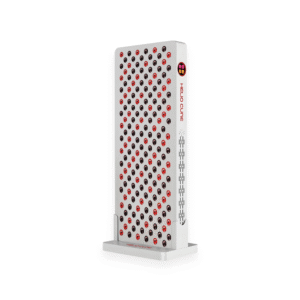
Let me keep this section reasonably plain. Here are the specifications that matter for this particular use:
- 216 LEDs, single-chip 3535 type, rated at 5 W each.
- Six wavelengths, specifically 630, 660, 810, 830, 850, and 1064 nm.
- Roughly 39 percent red, 42 percent near-infrared, and 19 percent deep near-infrared, which is that 1064 nm figure.
- Panel dimensions of 29.9 x 11.8 x 2.4 inches, weighing around 19.8 lb, on an iron frame.
- A touchscreen alongside a remote, offering five presets, a full-spectrum mode, and one custom mode.
- Adjustable pulsing from 0 up to 5000 Hz, with EMF reading 0.0 uT from 6 inches outward.
For a back and the deeper musculature underneath it, the near-infrared proportion is the number that ultimately matters, because red light at 630 and 660 nm concentrates closer to the surface of the skin. The wavelengths at 810 and 830 nm penetrate considerably deeper into the tissue, and the 1064 nm deep near-infrared travels deeper still. Since a stiff, overworked back is fundamentally not a skin problem, that near-infrared-heavy distribution is the appropriate shape for the job.
One clarification belongs here. The Glow runs five presets, one being a dedicated Pain and Inflammation mode, plus that single custom mode. If you have seen a Helio panel advertised with voice control, a tri-beam arrangement, or three separate custom modes, you were looking at the Blaze, a different model. The Glow carries none of those features, and I would rather you knew that now.
The Accredited-Lab Data
This is the portion I did not anticipate finding on a home panel. Helio Glow has been independently measured by LightLab International Allentown, an NVLAP-accredited laboratory, operating in continuous mode. These are third-party numbers rather than a promotional sheet the manufacturer assembled for itself. Here is what that laboratory recorded while the panel ran in continuous mode:
- Irradiance of 71.7 mW/cm2 at 6 inches, 75.0 at 12 inches, 65.3 at 24 inches, and 49.4 at 36 inches.
- Total radiant flux of approximately 125.8 W.
- A measured beam angle of 18.7 degrees, against the 19 degrees marketed.
- Flicker of 0.3 percent, formally rated as Low Risk.
- Six distinct LED wavelength peaks, all confirmed.
The reason this matters for a back session is fairly direct. You generally position yourself between 6 and 12 inches from the panel, and those happen to be the distances at which the measured irradiance registers highest. You are therefore receiving the stronger end of the panel’s output across a wide area at once, which is the combination a large muscle group benefits from. The low flicker reading is a comfort consideration too, since I keep this running in my peripheral vision while I answer email.
What The Research Actually Says
Red light therapy gets oversold almost constantly, and the device itself does not treat or resolve anything on its own. What I can responsibly share is what published studies on comparable wavelengths have found, along with the places those findings fall short.
A randomized trial from 2007 examined chronic low back pain using 810 nm low-level laser combined with exercise, measured against exercise alone. At the 6-week mark there was no additional benefit attributable to the laser. By the 12-week mark, however, the laser-plus-exercise group showed greater reductions in pain, amounting to roughly 1.8 cm on a visual analog scale, alongside improved lumbar range of movement and measurably less disability than the exercise-only group. The authors concluded the combination outperformed exercise alone over the longer term. The caveats deserve emphasis, because the benefit only materialized later, the effect sizes were modest, and the intervention relied on a laser rather than an LED panel like this one.
A sham-controlled trial from 2020 tested a pulsed 1064 nm laser for chronic nonspecific low back pain. After 6 weeks the active group had improved on disability, pain, and lumbar range of motion, while the sham group registered no significant change, and the between-group differences favored the active treatment. The same category of caveats applies here, because the study was short-term only, it employed a high-intensity clinical laser rather than a home LED panel, and the authors themselves explicitly called for larger, better-designed trials.
So read that evidence soberly. The encouraging signal is present, though it emerges mostly over the longer term or from clinical lasers, and notably not from a consumer panel resembling this one. I have consequently learned to treat the Glow as an aid I use alongside deliberate movement and stretching, rather than a solution operating on its own, and that framing keeps my expectations reasonable.
My Own Experience
Here is my personal slice, for whatever a single desk worker’s account is worth to you. I have used Helio Glow four or five afternoons per week for roughly two months, in sessions lasting between 10 and 15 minutes, seated about a foot away with the Pain and Inflammation preset selected, and I keep my eyes averted from the light itself.
What I noticed is that my back tends to feel a little looser afterward, and the warmth radiating off the panel is pleasant in an almost spa-like way. Whether that sensation comes from the light, or simply from the fact that I finally stood up and stopped hunching over my keyboard for ten minutes, is something I cannot separate out. Individual results vary enormously from one person to the next, you should absolutely talk to your own doctor, and this is only one of several things I happen to be doing.
Setup And Ergonomics
Assembling the whole arrangement took me comfortably under ten minutes, because the panel mounts onto its included floor stand and then tilts to whatever height suits you. Since the unit stands on its own, I keep it parked beside my desk and swivel my chair toward it whenever the mood strikes, standing for one session and sitting for the next. That flexibility is the real ergonomic advantage over any handheld device, because your hands remain free throughout and the coverage no longer depends on holding something perfectly still.
At 19.8 lb it is decidedly not something you casually toss into a bag, which makes it a stay-in-one-room piece rather than a travel companion. For a permanent desk setup, that stationary quality is fine, and it is in fact the whole point of choosing a panel this size.
Value And Comparisons
The pricing ladder arranges itself like this:
- Single Panel plus Floor Stand: $1,199.
- Twin Panel plus Rolling Floor Stand: $1,999.
- Quad Panel plus Electric Stand: $3,999.
For one desk-bound person covering a back and torso, the single configuration at $1,199 is the sensible pick. The twin arrangement makes sense if two people intend to share it or you want to wrap a larger portion of the body at once. The quad is a tall order for an ordinary home office, sitting much closer to a small commercial studio installation than anything a single worker requires.
The service terms are where I relaxed a little, because the package includes a three-year warranty, a 60-day risk-free trial with no restocking fee, and free shipping within the US. Two months is more than enough time to determine whether a panel this large has earned its permanent floor space.
The Verdict
Judged specifically as a floor panel for a desk worker who wants to cover an entire back in one continuous session, Helio Glow is a top-tier fit, and this is the narrow lens through which I am evaluating it. The coverage directly answers the frustration a small face panel creates, the independently accredited optical data is a rare and concrete point in its favor, and the trial paired with the warranty removes most of the financial risk from an expensive purchase.
I will not promise you that it will make your pain disappear, because the research does not support that statement. What I will say is that for larger-area, deeper-tissue use anchored at a desk, this is the most convincing panel I have parked in my office. Treated as an aid used alongside the unglamorous work of actually getting up and moving, it has earned its spot in the room.
My 5 out of 5 stars for this panel based on its specs and usage over the past few weeks.


