
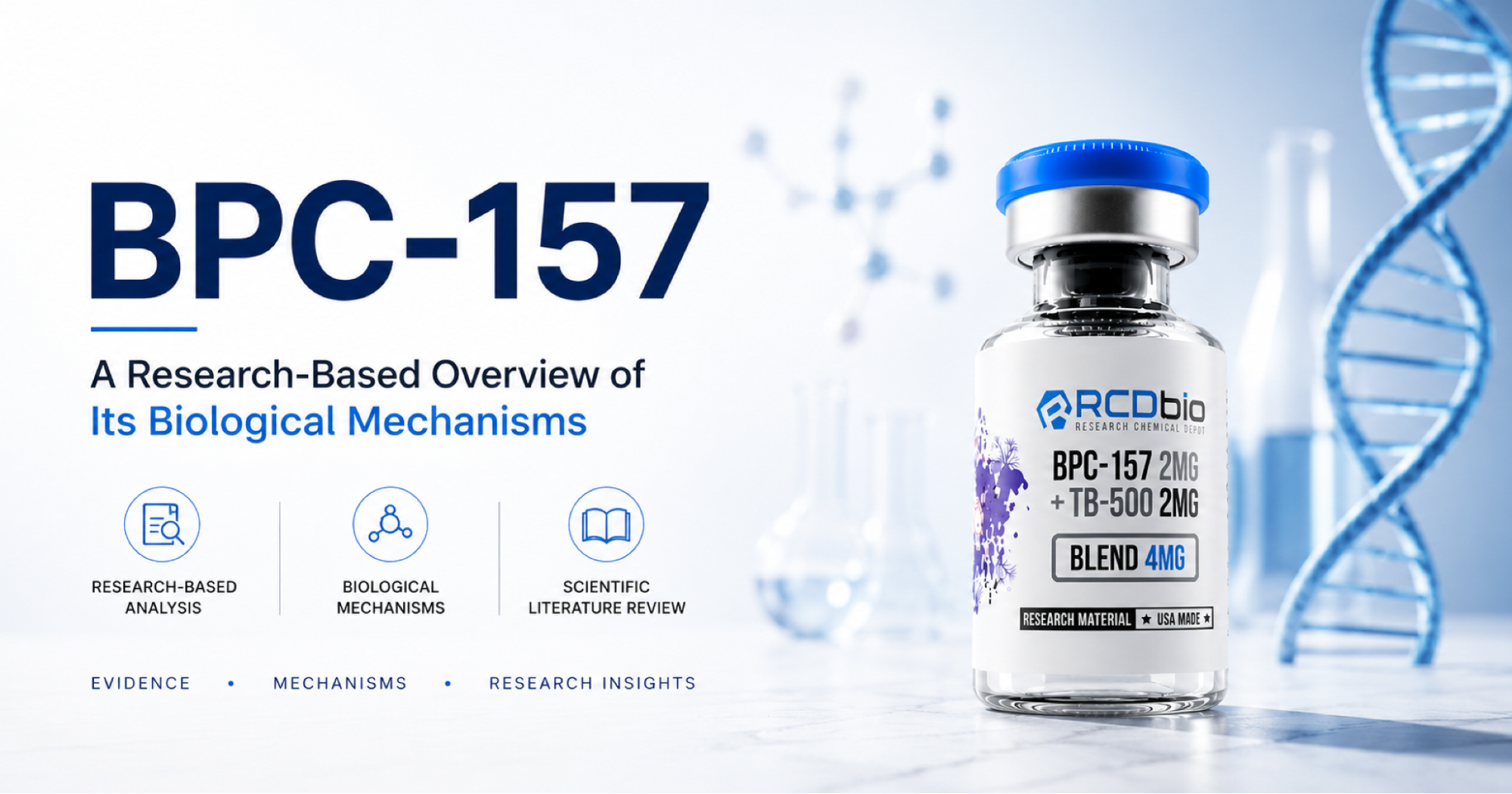
BPC-157 is a synthetic 15-amino-acid peptide (MW ≈1,419.5 g/mol, CAS 137525-51-0) derived from a gastric-juice protein. Preclinical research links it to three main mechanisms: VEGFR2/eNOS angiogenic signaling, Src-caveolin-1-eNOS nitric oxide modulation, and FAK/paxillin cell-migration signaling. It is not FDA-approved for any human or veterinary use, has no completed human clinical trial, and is listed under WADA’s S0 category as a prohibited substance in competitive sport.
BPC-157 is a synthetic peptide made from 15 amino acids, originally derived from a protein found in human gastric juice. It has been studied in preclinical models, cell cultures, and animal research for effects across a broader range of tissue types than most peptides of comparable size, including angiogenesis, nitric oxide signaling, and tendon, ligament, and muscle healing models.
It is not FDA-approved. It has not completed human clinical trials. Everything this article covers comes from lab and animal data, and that distinction matters throughout. As of July 2026, the BPC-157 evidence base consists entirely of preclinical data, plus one small IV safety pilot in two adults and one Phase 2 trial currently recruiting; no completed randomized controlled human trial exists for any indication.
Here’s what the published research actually found, mechanism by mechanism, with the limitations of each finding stated alongside it.
What Is BPC-157?
BPC-157 (also known by older designations including PL-14736 and bepecin) has the amino acid sequence Gly-Glu-Pro-Pro-Pro-Gly-Lys-Pro-Ala-Asp-Asp-Ala-Gly-Leu-Val, a molecular weight of roughly 1,419.5 g/mol, and CAS number 137525-51-0 (PubChem CID 9941957). It resists breakdown by gastric acid, a property tied to the sequence itself. Research-grade material is supplied as a white to off-white lyophilized powder, stored at −20°C and protected from light and moisture; sourcing guidance and certificate-of-analysis documentation for laboratory use are covered on RCDbio’s BPC-157 research compound listing.
Chemical and Molecular Properties
The table below extends the standard identity data with pharmacokinetic figures drawn specifically from the one dedicated PK study conducted in rats and beagle dogs. Every pharmacokinetic value here comes from that animal study and is labeled as such, since none of it has been established in humans.
| Property | Value |
| Compound name | BPC-157 (Pentadecapeptide BPC 157) |
| Peptide class | Synthetic pentadecapeptide (gastric-juice–derived fragment) |
| CAS Number | 137525-51-0 |
| PubChem CID | 9941957 |
| Molecular formula | C₆₂H₉₈N₁₆O₂₂ |
| Molecular weight | ≈1,419.5 g/mol |
| Amino acid sequence | Gly-Glu-Pro-Pro-Pro-Gly-Lys-Pro-Ala-Asp-Asp-Ala-Gly-Leu-Val (GEPPPGKPADDAGLV) |
| Amino acid length | 15 residues |
| Structural modifications | None reported — native fragment sequence |
| Proposed signaling targets | No single confirmed receptor; implicated across VEGFR2, Src-caveolin-1-eNOS, FAK/paxillin, growth hormone receptor, and MAPK/ERK1/2-linked pathways in preclinical studies |
| Elimination half-life | Under 30 minutes in rat and beagle dog studies following IV and IM administration, with linear pharmacokinetic behavior across tested doses — an animal value, not a human one |
| Tissue distribution | In radiolabeled rat studies, BPC-157 distributed rapidly and broadly across tissues after IV/IM dosing, with detectable radioactivity across multiple organ systems before clearance — an animal biodistribution finding, not a human one |
| Metabolism | Rapidly broken down into a set of smaller peptide fragments in vivo, which are further processed into free amino acids that enter normal amino-acid metabolism |
| Bioavailability (IM route) | Roughly 14–19% in rats and roughly 45–51% in beagle dogs — a species-dependent, animal-only finding |
| Excretion | Primarily renal (urine) and biliary pathways, based on radiolabeled tracer studies in rats |
| Appearance | White to off-white lyophilized powder |
| Solubility | Water-soluble; typically reconstituted in dilute acetic acid or sterile water for research assays |
| Storage | −20°C, lyophilized, protected from light and moisture |
| Research grade | For laboratory research use only |
| FDA status | Not approved for any human or veterinary indication; no completed large-scale human trials |
What Mechanisms Does the Research Point To?
BPC-157 isn’t studied around one dominant receptor. Instead, several distinct signaling pathways recur across the literature, each observed in a specific, named model system.
Angiogenesis (VEGFR2). In human endothelial cells and a rat hind-limb ischemia model, BPC-157 was associated with VEGFR2 activation and downstream Akt-eNOS signaling. In plain terms, the study found BPC-157 appeared to turn up a signaling cascade that cells use to grow new blood vessels and migrate, in that specific cell type, in a lab dish.
Nitric oxide signaling. In isolated rat aorta, BPC-157 modulated the Src–caveolin-1–eNOS pathway tied to nitric oxide production in vascular tissue. Think of it like loosening a clamp on a pipe flow increases, but the effect is specific to that vascular tissue type and hasn’t been shown to generalize beyond it.
FAK/paxillin cell migration. In rat Achilles tendon fibroblasts, BPC-157 was associated with increased phosphorylation of FAK and paxillin proteins that are part of the machinery a cell uses to grip its surroundings and pull itself forward alongside increased migration and survival in vitro.
MAPK/ERK1/2 signaling. In a rat alkali-burn wound model, BPC-157 was associated with ERK1/2 activation and faster wound closure, along with increased proliferation and migration of endothelial cells in a parallel in vitro assay. In plain terms, the cells in the dish that were exposed to BPC-157 grew and moved into the wound area faster than untreated cells, a lab-dish finding, not a healing-time claim for skin injuries generally. A 2025 systematic review places this pathway alongside VEGFR2 and FAK/paxillin as part of BPC-157’s broader mechanism profile.
What Does the Preclinical Evidence Show?
The densest body of BPC-157 research covers tendon, ligament, and muscle injury in rats. In Achilles tendon models, BPC-157 was associated with improved fibroblast migration and tendon-to-bone healing, including under corticosteroid interference. Similar improvements in functional and histological healing have been reported across independent rat ligament- and muscle-injury models, synthesized in a 2025 systematic review. Every finding here is species- and model-specific; none of it has been demonstrated in humans.
BPC-157 vs. TB-500: How the Two Compounds Compare
BPC-157 is frequently discussed alongside TB-500, a synthetic fragment of thymosin beta-4 built around the peptide’s actin-binding (“WH2”) domain. The two are studied through different primary mechanisms, and the distinction matters for anyone comparing them:
| BPC-157 | TB-500 | |
| Origin | Gastric-juice–derived fragment | Thymosin beta-4 actin-binding fragment |
| Primary proposed mechanism | VEGFR2/eNOS angiogenic signaling; FAK/paxillin cell migration | G-actin sequestration; cytoskeletal reorganization |
| Amino acids | 15 | 7 (Ac-LKKTETQ), from the 43-aa parent protein |
| Molecular weight | ≈1,419.5 g/mol | ≈889.0 g/mol |
| CAS Number | 137525-51-0 | 885340-08-9 |
| FDA status | Not approved | Not approved |
| Completed human RCT | None | None |
Because the two proposed pathways are largely complementary rather than overlapping, some laboratories investigate both peptides within the same tissue-repair research protocols. Neither compound has FDA approval or a completed human efficacy trial, so any comparison should be read as mechanism-to-mechanism, not outcome-to-outcome.
Regulatory Status
BPC-157 is not FDA-approved for any human or veterinary use. Its compounding-pathway status shifted in April 2026 when the FDA removed it from Category 2 of the 503A bulk substances list, though this is a compounding determination, not an approval. A Pharmacy Compounding Advisory Committee meeting on July 23–24, 2026, is set to further define its pathway. Separately, WADA lists BPC-157 under category S0 (Non-Approved Substances), prohibited at all times in competitive sport, and the U.S. Department of Defense has explicitly prohibited its use by Service Members. None of this changes the bottom line: no completed human clinical trial exists for any BPC-157 indication.
What Human Data Actually Exists?
Human evidence is limited to a two-person IV safety pilot with no control group or efficacy endpoint, an unpublished 2015–2016 U.S. Phase 1 oral trial, and a small retrospective knee-pain case series without blinding. A Phase 2, placebo-controlled trial for hamstring strain is currently recruiting but has not reported results. No completed, published, randomized controlled human trial exists for BPC-157 in any indication.
Where Are the Evidence Gaps?
A large share of the published literature originates from one research group, using a comparatively narrow set of models; independent replication remains limited. No chronic or long-term toxicity data exist in animals or humans. Open questions also include an unresolved debate in the peer-reviewed literature about the implications of BPC-157’s pro-angiogenic activity for cancer-relevant signaling pathways, raised in a 2025 literature review and disputed by the original research group. None of this is resolved either way; it’s an active area of scientific discussion, not a settled finding.
Risks and Limitations
Handling: BPC-157 should be handled by trained personnel in a controlled research setting, with standard PPE and biosafety protocols.
Exposure risks: Because BPC-157 has no single confirmed receptor target, off-target signaling effects can’t be ruled out from current evidence. Non-pharmaceutical-grade material carries added risk from contamination or inconsistent purity.
Storage: −20°C, lyophilized, protected from light and moisture.
Data limitations: No completed human efficacy trial exists for any indication, and the literature’s short observation windows mean long-term safety in either animals or humans remains unestablished.
Conclusion
The mechanistic throughline across BPC-157 research angiogenesis, nitric oxide signaling, FAK/paxillin-linked cell migration, and MAPK/ERK1/2 activity is consistent across tendon, muscle, and other injury models in rats. That’s a genuinely notable research profile, and one that distinguishes BPC-157 from single-pathway peptides like TB-500. However, it remains a preclinical compound: unapproved by the FDA, prohibited under WADA’s Schedule 0 category, and without a single completed, published human trial. The currently recruiting Phase 2 hamstring-strain trial is the clearest marker to watch for the first controlled human data. Researchers looking for research-only, third-party-tested material can findBPC 157 for sale through RCD Bio’s compound catalog.
FAQ
Is BPC-157 FDA approved?
No. BPC-157 has not been approved by the FDA for any human or veterinary indication, and it is not classified as a drug or dietary supplement. Its compounding-pathway status is under active review. The FDA removed it from Category 2 of the 503A bulk substances list in April 2026, but that’s a compounding determination, not a safety or efficacy approval. No regulatory body has cleared it for any medical use.
Has BPC-157 been tested in human clinical trials?
Only in a small, uncontrolled IV safety pilot involving two adults, and an unpublished U.S. Phase 1 oral trial from 2015–2016 that never reported results. A Phase 2, placebo-controlled trial for hamstring strain is currently recruiting but hasn’t reported outcomes yet. As of today, no completed, published, randomized controlled human trial exists for BPC-157 in any indication.
What are the main research areas for BPC-157?
BPC-157 is studied across several preclinical domains: angiogenesis and vascular signaling (VEGFR2/eNOS), nitric oxide pathway modulation, tendon and ligament fibroblast migration, muscle-injury recovery, and MAPK/ERK1/2-linked wound-healing signaling. All of this evidence comes from cell cultures and animal models; none of it has been established as a clinical effect in humans.
What is BPC-157’s regulatory status in sports?
BPC-157 is listed under the World Anti-Doping Agency’s S0 category, “Non-Approved Substances,” which covers any pharmacological substance lacking regulatory approval for human therapeutic use. This prohibition applies at all times, both in and out of competition, with no therapeutic-use exemption available to athletes. The U.S. Department of Defense has separately prohibited its use by Service Members.