
A shirtless man performs a barbell reverse lunge, focusing on his form and balance during the exercise.
I’ve been doing barbell reverse lunges for years, and they changed how I train legs. This exercise builds serious lower-body strength while being easier on your knees than forward lunges.
In this guide, I’ll show you exactly how to perform the barbell reverse lunge, which muscles it targets, and why it deserves a spot in your program.
You’ll learn proper form, weight selection, and variations to match your goals. I’ve coached this movement for over a decade, so I know what works.
What Is the Barbell Reverse Lunge Exercise?

A man performs a barbell reverse lunge in a gym, focusing on his form and balance during the exercise.
The barbell reverse lunge is a single-leg strength movement where you step backward, lower your body, then return to standing while holding a barbell.
Start standing with the barbell on your shoulders. Step one foot straight back and lower your back knee toward the ground. Keep your front shin vertical.
Push through your front foot to return to starting position. Your torso stays mostly upright while the front leg does the work.
The back barbell reverse lunge places the bar across your upper traps. This is the standard version that allows heavier weight. The front loaded barbell reverse lunge positions the bar across your front shoulders, demanding more core control.
Both work the same muscles, but front loading shifts more emphasis to your quads and challenges your core stability.
Barbell Reverse Lunge Muscles Worked

A man in a gym executes a barbell reverse lunge, showcasing proper squat form.
This exercise targets your entire lower body plus your core. Every rep builds strength across multiple muscle groups working together.
Quadriceps Involvement in the Barbell Reverse Lunge
Your quads do heavy lifting during this exercise. They control the descent and power the ascent. All four quad muscles activate, with the vastus medialis getting serious work.
Why the Barbell Reverse Lunge for Glutes is Highly Effective
Your glutes fire intensely during this movement. The front leg’s glute maximus drives hip extension as you stand up. The stepping motion creates a stretch at the bottom.
This stretch-and-contract pattern builds muscle size. The single-leg nature means each glute must work independently.
Hamstrings, Calves and Stabiliser Muscles
Your hamstrings assist throughout the movement. They help control knee flexion and support hip extension. Your calves stabilize your ankles while adductors and abductors keep your knee tracking properly.
Core and Upper-Body Support During the Barbell Reverse Lunge
Your abs and obliques work constantly to prevent rotation. Your upper back and shoulders support the barbell throughout each rep.
Barbell Reverse Lunge Form Guide
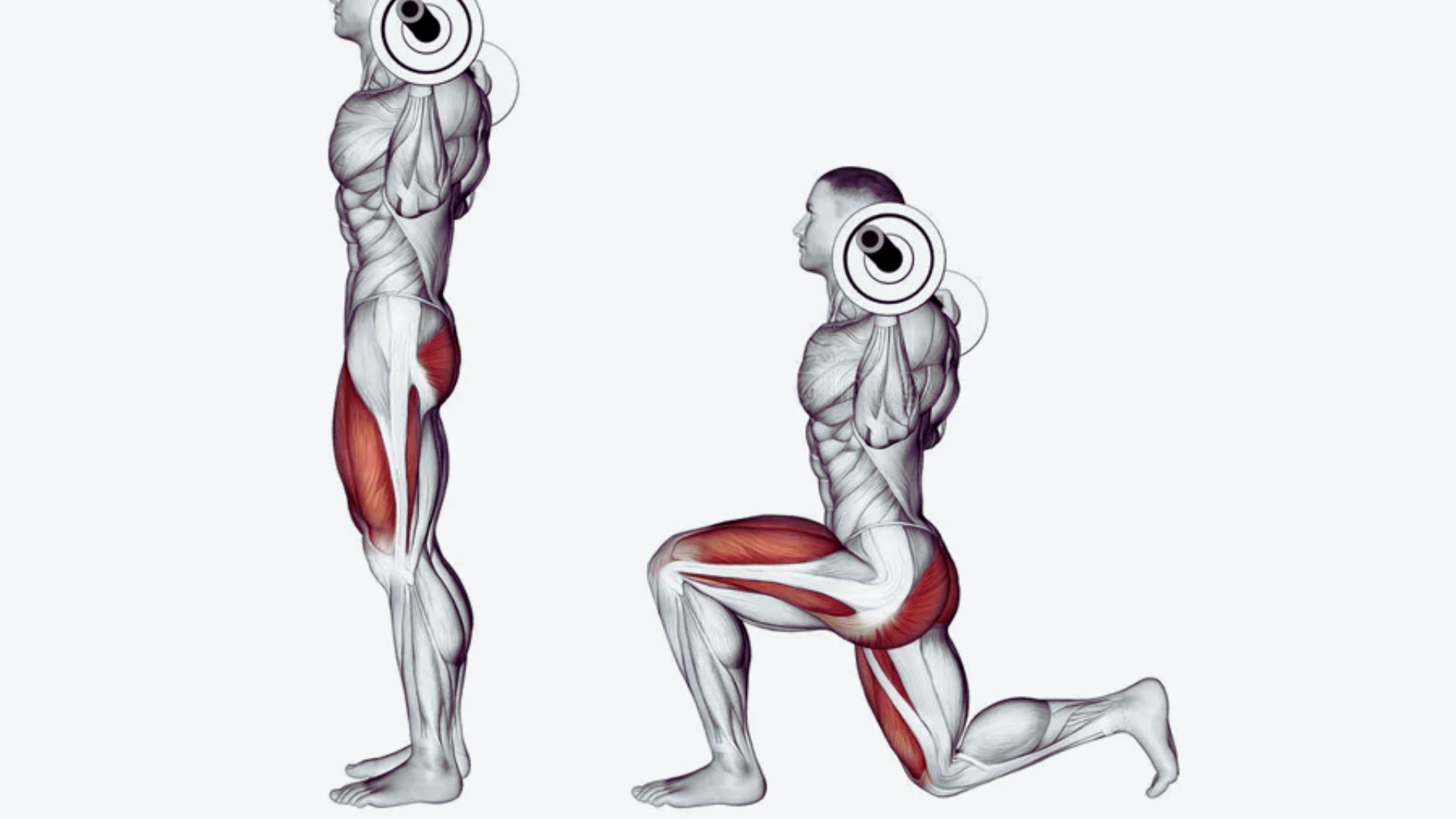
A man demonstrating a barbell reverse lunge, showcasing his leg muscles while squatting with a ball.
Proper form makes the exercise safe and effective. Small adjustments dramatically change how the movement feels.
Step 1: Setup And Starting Position
Start with feet hip-width apart. Position the barbell on your upper back and grip slightly wider than shoulder-width. Engage your core and look straight ahead.
Step 2: Step Backward
Take a controlled step straight backward with one foot.
Step 3: Lower Your Body
Bend both knees and lower your body. Your back knee moves toward the ground until it hovers an inch above the floor.
Step 4: Drive Back Up
Push through your front heel to stand back up. Keep your torso upright.
Step 5: Return To Starting Position
Bring your back foot forward to return to the starting stance.
Your stride length affects which muscles work hardest. A shorter stride emphasizes quads while a longer stride increases glute involvement. Most people land on a stride where feet end up two to three feet apart.
Barbell Reverse Lunge Benefits
The barbell reverse lunge offers specific advantages that make it worth including in your training program.
Builds Serious Leg Strength
This exercise builds leg strength through a full range of motion. The single-leg execution forces each leg to handle substantial weight, which directly improves squat performance over time.
Fixes Strength Imbalances
Training one leg at a time exposes side-to-side differences in strength. The barbell reverse lunge forces both sides to carry equal load, helping your weaker leg catch up and reducing injury risk.
Easier On Your Knees
The backward stepping pattern is gentler on your knee joints than forward lunges. Your front shin stays more vertical, positioning your knee over your ankle instead of pushing past it.
Low Joint Stress, High Training Value
This exercise provides a solid training stimulus without excessive joint stress. You can include it frequently in your program without breaking down or needing long recovery periods.
Carries Over To Real Life
The movement pattern translates directly to everyday activities like climbing stairs, getting up from kneeling, and decelerating during sports. Training this pattern makes daily movement feel easier and more controlled.
Barbell Reverse Lunge Weight Selection

A man in a blue tank top performs a barbell reverse lunge, focusing on strength training and balance.
Choosing the right weight determines whether you build strength safely or risk injury.
Start with just the empty barbell (45 pounds) if you’re a beginner. A good starting point is 50-60% of what you can squat for reps. Add 5 to 10 pounds per session once your form feels solid. Track your weights to see progress over time.
For Strength: 3-6 reps per leg, 3-4 sets, rest 2-3 minutes.
For Muscle Growth: 8-12 reps per leg, 3-4 sets, rest 60-90 seconds.
For Endurance: 15-20 reps per leg, 2-3 sets, rest 45-60 seconds.
Barbell Reverse Lunge Variations

A man performs a barbell reverse lunge, squatting with a barbell across his shoulders in a gym setting.
Different variations let you target specific muscles or work around limitations.
Alternating Barbell Reverse Lunge
Alternate legs each rep instead of completing one full side. Step back with your right leg, return, then step back with your left leg. This provides built-in rest for each leg.
Front Rack Barbell Reverse Lunge Variation
The bar rests across your front shoulders in a clean position. This increases quad emphasis and demands more core stability.
Front Loaded Barbell Reverse Lunge Variation
This covers holding weight in front of your body. Front loading reduces lower back stress and makes it easier to maintain an upright torso.
Barbell Reverse Lunge Front Foot Elevated
Place your front foot on a small platform. This increases range of motion and creates more muscle stretch. Start with a 2-4 inch elevation.
Raised Barbell Reverse Lunge Variation
Your back foot elevates on a bench. This creates a Bulgarian split squat. The rear foot elevation shifts even more load to the front leg.
Smith Machine Barbell Reverse Lunge
The Smith machine provides a fixed bar path. This can help beginners learn the movement pattern. I prefer free weight versions for most trainees.
Conclusion
The barbell reverse lunge has been a cornerstone in my leg training for good reason. It builds strength, fixes imbalances, and spares your joints in ways most exercises can’t match. I still feel these working after years of training, which tells me they deliver real results.
Start with the basic version, master your form, then experiment with variations that match your goals. Your legs will thank you months from now when you’re stronger and more balanced.
The difference in your squat and overall leg development will be noticeable. Try adding them to your next leg day and see for yourself.
Drop a comment below and let me know how it goes.
Frequently Asked Questions
Is the barbell reverse lunge better than forward lunges?
Reverse lunges are easier on the knees because of the backward stepping pattern. Forward lunges create more shear force on the knee joint.
How heavy should I go on barbell reverse lunges?
Start with 50-60% of your back squat weight. Progress slowly by adding 5-10 pounds per session once your form is solid.
Can I do barbell reverse lunges every day?
No, your muscles need recovery time. Twice per week is plenty for most people. Daily training would lead to overtraining.
Should I feel barbell reverse lunges in my glutes or quads?
You should feel both working. A longer stride emphasizes glutes more, while a shorter stride hits quads harder.
What’s the difference between barbell reverse lunge and Bulgarian split squat?
The Bulgarian split squat elevates your back foot on a bench. The standard barbell reverse lunge keeps both feet on the ground.