

Most serious gym-goers have the training side figured out. They track their lifts, hit their macros, and show up consistently. But recovery – real, structured recovery – is where a lot of people are still leaving gains on the table.
Sleep, protein, and foam rolling are the baseline. They’re non-negotiable, and if you’re not doing them, start there. But above that baseline, there’s a tier of recovery tools that elite athletes have been using for years. One of them is hyperbaric oxygen therapy, and it’s no longer something you can only access at a private sports clinic.
Home hyperbaric chambers have moved from professional sports facilities into athletes’ living rooms and garage gyms. The research backing them is getting more serious, and the cost of entry is coming down. Here’s what gym-goers need to know.
What Hyperbaric Oxygen Therapy Actually Does
Inside a hyperbaric chamber, you breathe 100% oxygen at pressure levels above normal atmospheric pressure. That increased pressure forces more oxygen into your blood plasma – not just into red blood cells, but dissolved directly into the liquid of your blood. The result is that oxygen reaches damaged and inflamed tissue that restricted circulation might otherwise struggle to supply.
According to a 2025 review in the Turkish Journal of Sports Medicine, HBOT reduces cellular edema, lowers inflammation, promotes angiogenesis (the growth of new blood vessels), and accelerates the repair of soft tissue. These are the exact mechanisms athletes need when they’re trying to recover from hard training.
For athletes who want regular access without booking clinic appointments, a hyperbaric chamber for home makes consistent sessions practical. Soft-shell home units typically operate at 1.3 to 1.5 ATA – lower than the 2.0 to 2.5 ATA you’d see in clinical settings, but sufficient for post-exercise recovery and fatigue reduction.
The Recovery Science: What Studies Actually Show
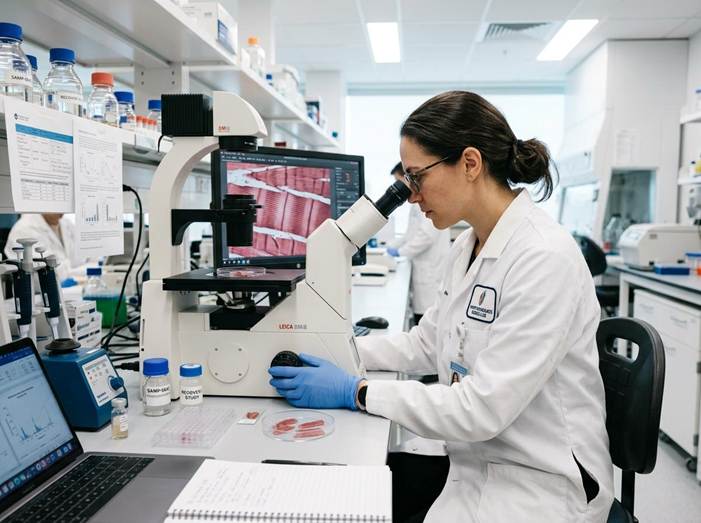
The evidence isn’t just anecdotal. A 2025 systematic review and meta-analysis published on PubMed examined 10 studies covering 299 subjects and found that HBOT significantly accelerated recovery from exercise-induced muscle injury (95% CI, -76.19 to -33.11; P<.0001). Importantly, 100-minute sessions outperformed 60-minute sessions across varying pressure levels.
For gym-goers, “exercise-induced muscle injury” is the clinical term for what you feel after a heavy squat session or a brutal eccentric-focused workout. It’s the tissue damage that drives delayed onset muscle soreness. HBOT appears to address the damage side of that equation directly, reducing the inflammatory load that slows repair.
A 2024 randomized double-blind trial in Frontiers in Physiology tested 20 elite youth football players. Those who received a single 60-minute HBOT session after a match showed significantly lower Hooper Index fatigue scores one hour post-match compared to the control group – 8.6 versus 11.0. One session, measurable difference.
That said, protocols aren’t standardized yet. A 2025 narrative review in Undersea and Hyperbaric Medicine noted that while the evidence for HBOT in athletic recovery is growing, researchers are calling for larger trials with more consistent designs. The science is solid enough to take seriously – it’s not yet solid enough to treat every finding as settled.
Who Should Think About Home HBOT
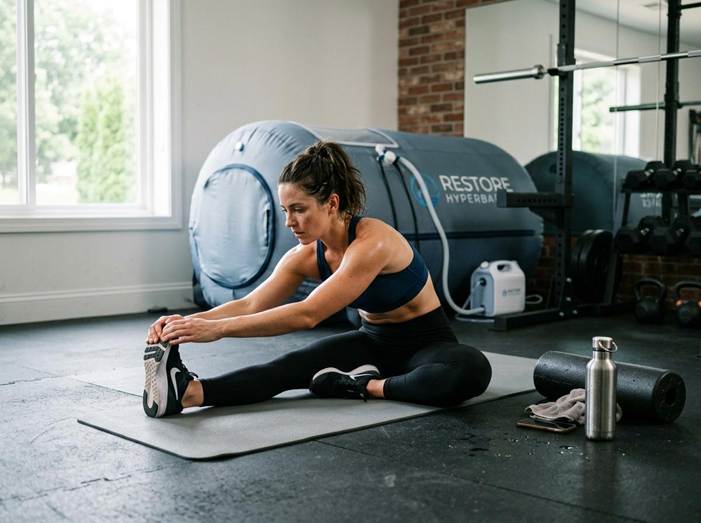
Home HBOT isn’t for someone who’s sleeping five hours a night and skipping post-workout nutrition. Sort those basics out first. The benefit of hyperbaric therapy compounds on top of an already structured recovery routine – it doesn’t substitute for one.
The best fit is someone training four or more days per week who’s hitting consistent plateaus in recovery time. Competitive gym-goers, team sport athletes, CrossFit athletes, and anyone dealing with recurring muscle fatigue between sessions will feel the difference most clearly. DOMS – the soreness that peaks 24 to 48 hours after training – is one indicator that the tissue damage is significant enough that faster repair would be worth having. Understanding whether muscle soreness signals progress or something else is a useful starting point before deciding if HBOT fits your training.
It’s worth being direct: this is a performance investment. A quality home unit costs between $7,500 and $17,000 depending on spec. If you’re training consistently and treating recovery as seriously as your training load, it can justify itself. If you’re still figuring out your programming or skipping sleep, it won’t move the needle.
Choosing a Home Chamber: What Gym-Goers Need to Know
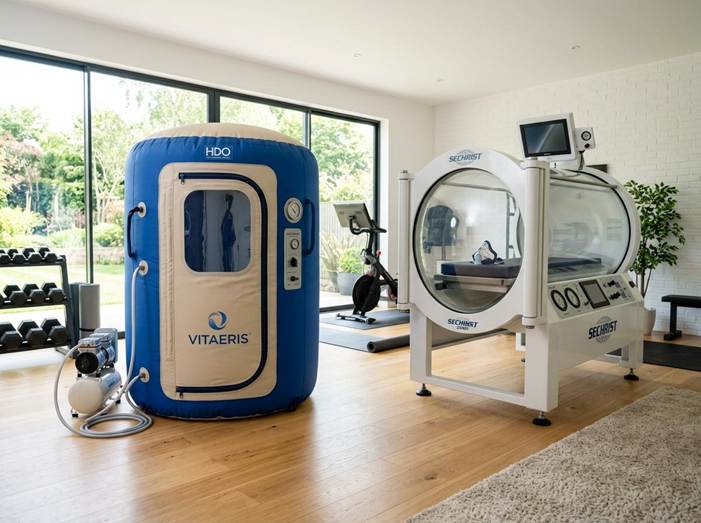
There are two categories to know: soft-shell and hard-shell.
Soft-shell chambers are inflatable, portable, and operate at 1.3 to 1.5 ATA. They don’t require professional installation, and in most regions they don’t require a prescription. They’re what most serious gym-goers and home users opt for. The pressure ceiling is lower than clinical units, but for post-exercise recovery and fatigue reduction that pressure range is where the research on home use sits.
Hard-shell chambers reach 2.0 ATA and above – the territory of clinical protocols for wound healing, decompression sickness, and serious injury rehabilitation. They require professional installation and are significantly more expensive. Unless you’re working with a sports medicine team that’s prescribed clinical-level HBOT, a soft-shell unit is the practical starting point.
On session length: the 2025 meta-analysis found that 100-minute sessions outperformed 60-minute ones, but 60 minutes is the standard entry point for post-exercise use. Three to four sessions per week post-training can produce cumulative recovery benefit. The Turkish Journal of Sports Medicine 2025 review recommends individualizing session number and duration based on training demands – there’s no one-size-fits-all protocol.
Always check with a healthcare provider before starting, especially with any cardiovascular or respiratory history. Ear pressure sensitivity and claustrophobia are the most common practical issues people encounter.
Building HBOT Into Your Training Week
The timing that makes the most physiological sense is post-session – within one to two hours of finishing intense training – when acute inflammation is at its peak and tissue repair is just beginning. That’s when the anti-inflammatory and oxygen-delivery effects of HBOT are most relevant.
Here’s a practical weekly structure for an athlete training five days:
- Monday (heavy lower body): HBOT session Monday evening
- Wednesday (upper body strength): HBOT session Wednesday post-training
- Friday (conditioning or sport): HBOT session Friday evening
- Saturday (competition or match): HBOT session within two hours of finishing
It doesn’t need to match every training session. Three to four sessions per week is enough to produce a cumulative effect, and more isn’t necessarily better – especially at the 1.3 to 1.5 ATA range of home units.
Stack HBOT with the recovery fundamentals, not instead of them. Hydration, protein intake, and sleep are the base that HBOT builds on. If you’re not recovering consistently, why gains fade without consistent recovery stops being abstract – it shows up in your training log over months. HBOT is one of the tools that makes consistent recovery achievable across a high-frequency training week.
The goal isn’t to add complexity to your routine. It’s to remove the bottleneck that incomplete recovery creates, so you can train harder, more often, without the body accumulating debt it can’t repay.
Recovery Is Where Progress Happens
The athletes who recover fastest train more effectively over time. That’s not a motivational statement – it’s a physiological reality. Tissue repair, adaptation, and performance gains all happen between sessions. The training session creates the stimulus; recovery is where the result gets built.
Hyperbaric therapy is one of the few recovery tools with a growing body of controlled research behind it, not just celebrity endorsements and social media buzz. The 2025 meta-analysis data is meaningful. The football RCT is meaningful. The fact that the home care segment is the fastest-growing area of the HBOT market reflects a real shift in how serious athletes think about recovery infrastructure.
Home HBOT won’t replace the basics. But for athletes who’ve already built them and want to know what’s next, it’s a tool worth taking seriously.


